+61 415 139 814
  +91 875 047 8831

Wars That Never End: What Are Perpetual Wars?
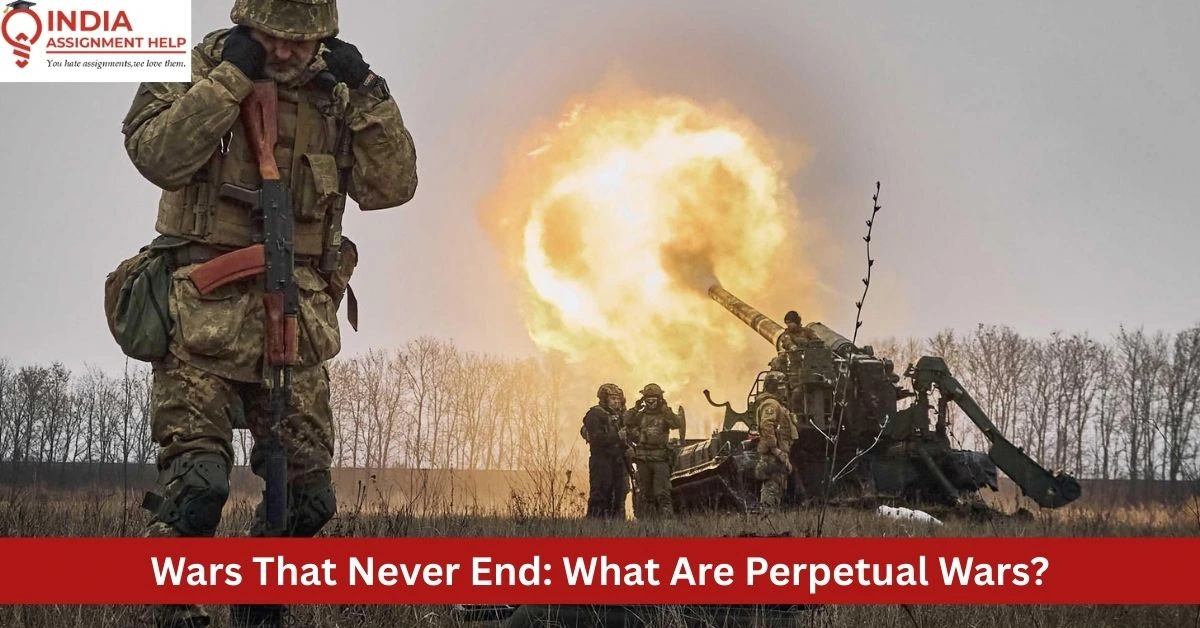
If there is one thing that has remained constant about human civilization in all of recorded history, it’s that humans can never stay at peace for too long. The First World War was called the ‘war to end all wars,’ and look what happened just two decades later, another catastrophic global conflict. Experts thought the Second World War would force the world’s great powers to focus on rebuilding and maintaining peace rather than fighting, but the Cold War ensued, in which multiple proxy wars were fought. Even the end of the Cold War wasn’t enough to stop armed conflict once and for all. One could argue that the world has been in a state of perpetual war since humans first began to think. Now you might be wondering, what is perpetual war? In this blog, we will discuss the armed conflicts that seemingly never end, causing death and destruction for an extended period due to political, military, diplomatic, or geological hurdles.
Perpetual War Meaning
The term ‘perpetual war,’ also known as endless war or forever war, refers to an armed conflict that continues for an extended period of time with no clear conditions that could lead to its conclusion. These wars are usually situations of ongoing tensions that may escalate at any moment, and like these unresolved issues, the wars also continue to drag on with no end in sight. That was the traditional perpetual war meaning. Let us look at some of the most notable perpetual war examples in the world today.
Deadliest Ongoing Conflicts In The World Today
a) Myanmar Insurgency:
The South Asian country of Myanmar has suffered from conflict for a long time, including one of the most brutal ongoing wars today. Myanmar is an ethnically diverse country, and multiple ethnic groups are fighting the state military for freedom. Myanmar has a history of military dictatorships, the most recent of which seized control in 2021. It is estimated that the Myanmar civil insurgency resulted in at least 15,000 casualties in 2025.
b) Arab-Israeli Conflict:
Perhaps the most polarising conflict in recent years, the state of Israel has been involved in fierce conflicts with its neighboring Arab states ever since its foundation in 1948. With more than 28,000 casualties in 2025, the conflict has seen Israel fighting against Palestine, which is fiercely supported by states like Qatar, Iran, Iraq, Yemen, Lebanon, Jordan, and Syria.
c) Civil War In Somalia:
Somalia has been engulfed in a brutal civil conflict for over 35 years. It has been referred to as a perpetual war, as it initially began in response to the despotic rule of Siad Barre, but has persisted for much longer despite Barre’s fall from power because of multiple warlords seeking to control more territory. Multiple armed factions have fought in this conflict, and two unrecognized quasi-states have been carved out of Somalia in 1991 (Somaliland) and 1998 (Puntland), respectively. Last year witnessed more than 10,000 casualties in the Somali Civil War.
d) Conflicts In The Congo:
The conflicts in the Congo region have claimed more than 10,000 lives in 2025. The conflict has never remained within the borders of the DRC, as there have been constant interventions and spillovers, particularly into the countries of Rwanda, Burundi, Uganda, and the Central African Republic. The Democratic Republic of the Congo was home to an almost pan-African war from 1998 to 2003, which resulted in the loss of 5.8 million lives, making it the deadliest conflict since the Second World War.
e) Extremist Insurgency In The Maghreb/Sahel:
The Maghreb is a region of North Africa that is home to what is possibly the longest war ever against Islamic extremist militants. At first, the conflict was against the terrorist group Al Qaeda, but several extremist groups pledged their allegiance to Abu Bakr al-Baghdadi and the Islamic State in 2014. The conflict claimed more than 21,000 lives in 2025, and the countries affected include Cameroon, Chad, the Ivory Coast, Libya, Mali, Mauritania, Morocco, Nigeria, Togo, Tunisia, and Niger.
f) Mexican Drug War:
The country of Mexico is home to violent and ruthless drug cartels that are vying for power against each other. Since 2006, the cartels have engaged in a domestic battle against each other and the Mexican government. There have been close to 10,000 casualties in 2025, and it seems like the battle against cartels will be known as the longest war in the world against organised crime.
g) Sudanese Conflicts:
Sudan has been involved in some form of civil conflict since 2008. Originally in opposition to dictator Omar al-Bashir, the conflict led to the birth of the nation of South Sudan in 2011. Even the creation of a new country didn’t stop the violence, as the military dictatorship of Sudan is involved in a ruthless struggle against other military factions in a devastating campaign of war and massacre that has claimed the lives of nearly 80,000 people in 2025, with most of them being helpless civilians.
h) Russo-Ukrainian War:
Former Soviet states Russia and Ukraine engaged in the Crimean conflict in 2014, which resulted in Russia annexing the Crimean peninsula. However, everything changed for the worse after Russia launched a full-scale invasion of Ukraine in 2022. Considered one of the most devastating ongoing wars in the world, the conflict claimed more than 80,000 lives last year alone.
Longest Ongoing Wars Today
1) The Conflict In Myanmar (since 1948):
The civil insurgency in Myanmar is one of the foremost perpetual war examples in the world. The conflict has raged on between the military junta and the diverse ethnic groups of the country for almost 78 years continuously, and unfortunately, there doesn’t seem to be an end in sight.
2) The Israel-Palestine Conflict (since 1948):
Almost all Arab states were unhappy with a Jewish state being set up in the centre of a historically Arab-dominated region. The Arab states have frequently fought against Israel and lost conflicts in 1948, 1967, and 1973. Despite some Arab countries coming to a hesitant peace with Israel, the deeply ethno-religious reasons will probably cement this conflict as the crown jewel example of a perpetual war.
3) Kurdish Nationalist Conflicts (since 1918):
With nearly 300 casualties in 2025, the Kurdish insurgency in countries like Iran, Iraq, Syria, and Turkey remains the longest war ever that is still going on right now. The Kurds are considered to be the largest ethnic group without a separate state, and they have fought for political sovereignty against the now-defunct Ottoman Empire, Imperial Iran, Kingdom of Iraq, Ba’athist Iraq and Syria, and the present-day Islamic republics that govern these countries.
4) Insurgencies In Iran (since 1918):
Iran is home to one of the longest ongoing wars in the world today. Primarily, Iran’s civil conflict is driven by the Kurdish fighters who have been seeking independence from the Persian state ever since former Shah Reza Shah rose to power during the twilight years of the Qajar dynasty. Iran’s response to Kurdish separatism is significantly less brutal than that of neighboring nations, although it has staunchly opposed Kurdish nationalism for more than a century.
5) Insurgencies In Turkey (since 1922):
The end of the First World War and the Turkish War of Independence led to the Kurdish insurgency in 1922. For more than a hundred years, Kurds have demanded political freedom from the erstwhile Ottoman Empire and the modern-day Turkish Republic. The Kurdish rebellion also claims territory from Iraq and Syria, making this century-old conflict a problem for three countries.
6) Jamaican Political Conflict (since 1943):
The political conflict is not exactly a war, but it can be described as a series of violent confrontations between right-wing and left-wing political groups in the country. The political groups in question are the Jamaican Labour Party (JLP) and the People’s National Party (PNP). It can be described as the longest war ever purely motivated by a political agenda, although it has remained a low-intensity conflict with over 290 casualties in 2025.
7) Kashmir Conflict (since 1947):
The Kashmir conflict often gets brought up in the ‘longest war in history’ discussions. India and Pakistan have fought over the state of Kashmir ever since Hari Singh, the Hindu ruler of the Muslim-majority state, decided to join India after the countries were partitioned. The conflict has had varying intensities over its history, with a heightened escalation in 2025 following a terrorist attack on Indian nationals.
8) Insurgencies In Pakistan (since 1948):
As if Pakistan wasn’t already fighting an old enemy on one front, the country has been fighting several internal insurgents for nearly 80 years. There is the independence movement in Balochistan and a militant insurgency in Khyber-Pakhtunkhwa, and if that wasn’t enough, there have been struggles with the Islamic State and border clashes with the newly established Taliban government of Afghanistan.
9) Insurgencies In India (since 1954):
Like its neighbor and old enemy, India is home to several ongoing conflicts, particularly separatist movements. The North-Eastern states of India have struggled with several insurgent movements that have spilled over into Myanmar and Bhutan as well. The state of Jammu and Kashmir is also infested with a domestic insurgency along with a lengthy international conflict. India has also grappled with a communist militant insurgency for almost 60 years now, which has claimed more than 15,000 lives.
10) Papua Conflict (since 1962):
The Government of Indonesia has been fighting a separatist group called the ‘Free Papua Movement’, which aims to liberate the Papua province and establish a separate, sovereign state. It is one of the longest ongoing wars today, but it has remained a relatively low-intensity insurgency with nearly 253 casualties in 2025.
Which Was The Longest War In History?
Have you ever wondered what the most extreme example of a perpetual war is? There are some conflicts that have lasted hundreds of years, and even today their impact is felt. Let us look at the longest war in the world, and some of the other longest wars in history that dragged on for centuries.
War |
Duration |
Belligrents |
Causes |
Casualties |
Reconquista |
718-1492 (774 years) |
Northern Christian Polities and Islamic States of Al-Andalus |
Christian efforts to retake Spain and the Iberian Peninsula from Muslim occupiers |
7 million (estimated) |
Anglo-French Wars |
1109-1815 (706 years) |
England and France |
Ambitions to become the dominant power in Western Europe |
Several million |
Roman-Persian Wars |
54 BC-628 AD (681 years) |
Roman Republic/Empire and the Persian Empires |
Wars of influence between the most dominant civilisations in the world at that time |
Difficult to estimate (a couple of million estimated) |
Byzantine-Bulgarian Wars |
680-1355 (675 years) |
Byzantine Empire and Bulgarian Kingdoms |
Byzantine response to a perceived Bulgarian imperialist threat |
Tens to hundreds of thousands |
Roman-Germanic Wars |
113 BC-476 AD (588 years) |
Roman Republic/Empire and Germanic Tribes |
Roman conquest of Germanic territory and the subsequent uprising of the Germanic peoples |
A couple of million casualties |
Arab-Byzantine Wars |
629-1180 (551 years) |
Arab Muslim Caliphates and the Byzantine Empire |
Muslim expansionism into Byzantine territories |
A couple of million casualties |
Yaqui Wars |
1533-1929 (396 years) |
Spain, Mexico, the United States, and the Yaqui Tribes |
Wars of imperialism to capture territory from the indigenous Yaqui people |
A couple of hundred thousand casualties |
Yemeni-Ottoman Conflicts |
1538-1911 (373 years) |
Ottoman Empire and Yemeni Zaidi Tribes |
Ottoman invasion of Yemen |
A couple of hundred thousand casualties |
Moroccan-Portuguese Conflicts |
1415-1769 (354 years) |
Morocco and Portugal |
Moroccan resistance to Portuguese colonialism |
Several thousands |
Russo-Turkish Wars |
1568-1918 (350 years) |
Russian Tsardom/Empire and the Ottoman Empire |
Russian expansionism into Southern Europe and Ottoman resistance and expansionism |
Over 1 million |
What Are The Causes Of Perpetual War?
Wars usually don’t last very long, but there are often some reasons that prolong wars far longer than they should have lasted. Here are some of the most common reasons for perpetual wars.
? Economic/Industrial Interests:-
Wars have been an economic gamble for years, and in recent years, the military-industrial complex has led to wars becoming fully commercialised. This is why some conflicts are deliberately prolonged for monetary gain.
? Resource Competition:-
It is predicted that by the end of the 21st century, most wars will be fought over resources. With natural resources running out, countries will likely attack weaker nations that are rich in resources, and the uprisings from there will fuel a conflict for many years.
? Political Distraction:-
Governments have been known to start wars to distract people from domestic issues. Prominent examples include the Falklands War (1982) and the Russo-Japanese War (1904-1905).
? Ideological/Ethnic Conflicts:-
Ethnic conflicts don’t disappear overnight, and neither do ideological differences. Deep-seated differences can lead to endless cycles of fighting that go on with seemingly no end in sight.
? Military Stalemate and Poor Strategy:-
Vague military objectives, an inability to control territory, and logistical issues can cause the war to get stuck and never effectively end. Poor strategy often contributes to wars being stuck in a stalemate for several years.
Modern-Day Conflicts Which Might Turn Into Future Perpetual War Examples
There are some conflicts in the present day that experts fear might turn into long-term wars. As we have already discussed some of the longest ongoing wars in the world, we should also take a look at some conflicts that have the potential to last for a significantly long period of time. Here are some modern conflicts that might turn into perpetual war examples in the future.
a) Russo-Ukrainian War:
Most people expected Russia’s campaign in Ukraine to end with a swift conquest, but it has continued to drag on for 4 years, thanks to Ukrainian resistance and the international support received by the country. It is likely that the conflict will become one of the longest ongoing wars in the world because both sides are adamant, and it doesn’t seem like they will come to a peaceful conclusion anytime soon.
b) Spillover From The Arab Spring:
The Arab Spring revolution led to a lot of bloodshed. However, countries like Libya, Syria, and Yemen have suffered the most. With the fall of the Assad regime, it is possible for Syria to gradually enter a period of stability similar to what happened with Iraq, and Libya is still rife with insurgents despite peace treaties being signed. Yemen, on the other hand, is still struggling, and regional powers like Iran and Saudi Arabia continue to manipulate the conflict to expand their own presence internationally.
c) India-Pakistan-China Conflict:
India is a growing power, China is already a great power, and Pakistan is a notable regional power. All of these nuclear-armed countries are in conflict in Kashmir. India has to fend off two enemies at once while also battling internal threats, and it doesn’t seem like China will stop supporting Pakistan anytime soon. The Kashmir issue will likely be known as one of the longest ongoing conflicts in the world, as the relations between India and Pakistan are at an all-time low as of now.
d) Insurgencies in Africa:
Post-colonial Africa was rife with ethnic disputes, and a series of long-term despotic rulers did nothing but breed angst in the minds of the people. Opposition to totalitarianism and ethnic hatred has caused multiple wars in the African continent, and it seems like Africa will continue to struggle with conflict for an unpredictable period of time.
e) Afghanistan Conflict:
Afghanistan has been embroiled in chaos ever since the Soviets invaded in 1978. The conflict turned into a hotspot for Islamic extremist groups like Al Qaeda and the Islamic State, and they continue to fight the reigning regime in the country. The erstwhile Taliban-led emirate was overthrown in 2001 following the US-led invasion, which would become the longest war ever in US history. Even after the American withdrawal and the Taliban’s reconquest, the battle in Afghanistan doesn’t seem to have settled down.
Conclusion
Humanity has never learned from the bloodshed of conflicts, and it seems like we are still in a state of perpetual war. However, we can hope for a better future and work towards building a world where war and violence would no longer be the first option for governments to resolve disputes. Some of the deadliest ongoing wars today could have been prevented by diplomatic resolution, but, being humans, they dragged on the battle far longer than they should have at the expense of others.