+61 415 139 814
  +91 875 047 8831

Cement Production in Lithuania Report Writing Help
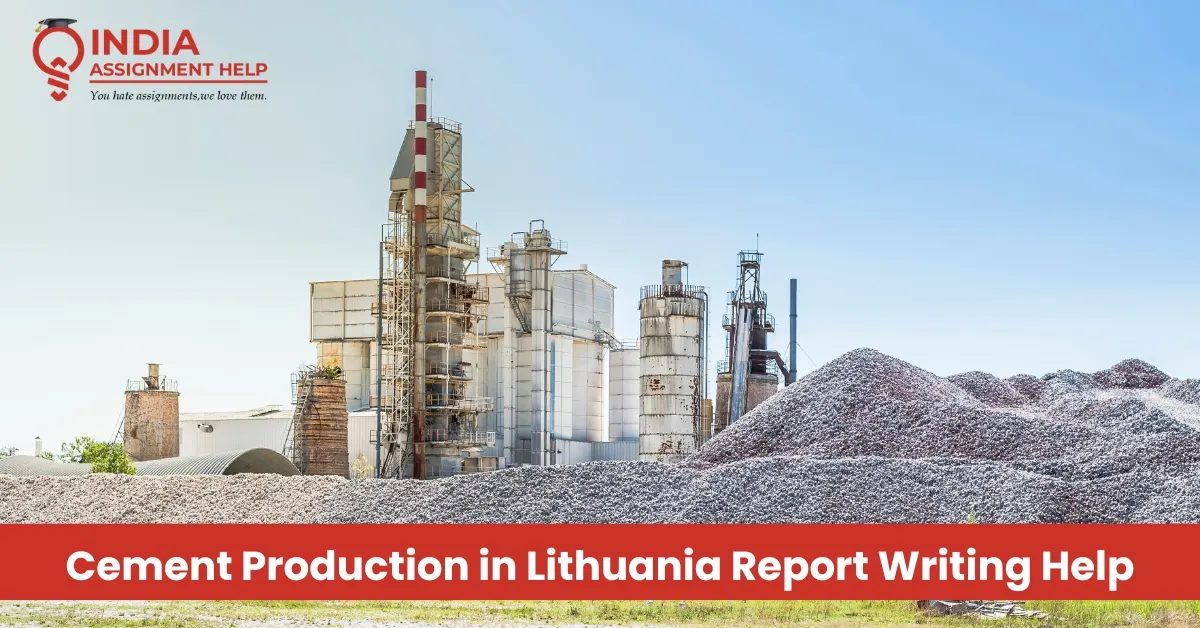
Cement Production in Lithuania Report Writing Help supports students in Canada who need to write academic reports on the cement industry in Lithuania. Lithuania has a well-regulated cement manufacturing sector that follows European quality and environmental standards. In most academic reports, students begin by explaining what cement production involves and why it is important for construction and national development. This includes discussing how cement is used in roads, buildings, and infrastructure projects.
Students are also expected to describe the industry background, overall scope, and relevance in a clear way. Writing this information in a structured manner helps readers understand the topic easily. Clear organisation and simple explanation are important to meet Canadian university academic requirements.
Overview of Cement Manufacturing Practices Followed in Lithuania
Cement Production in Lithuania Report Writing Help explains the main manufacturing practices followed by cement plants in Lithuania clearly and simply. Cement production begins with the extraction of raw materials such as limestone and clay from quarries.
These materials are crushed and mixed to create a raw mix with the required chemical composition. The raw mix is then heated in large rotary kilns at very high temperatures, where it turns into a material called clinker. After cooling, the clinker is finely ground with a small amount of gypsum to produce cement.
Each stage of this process is important because it affects the final strength, quality, and durability of the cement. Informational reports describe these steps in the correct order so readers can easily understand how cement plants operate. This structured explanation helps students studying in Canada present manufacturing practices accurately and meet academic expectations.
Types of Cement Commonly Used in Lithuanian Construction Projects
Cement Production in Lithuania Report Writing Help explains the main types of cement used in Lithuanian construction so students can understand their purpose clearly. The most common types are explained below in simple terms.
Ordinary Portland Cement
- This is the most widely used cement type in Lithuania.
- It is used for general construction such as residential buildings, offices, pavements, and small infrastructure projects.
- It provides good strength and normal setting time, which makes it suitable for everyday construction work.
- This type is easy to handle and is commonly used in concrete and mortar applications.
Blended Cement
- Blended cement is produced by mixing Portland cement with materials such as fly ash or slag.
- It is preferred for projects that require better durability and long-term strength.
- This type generates less heat during setting, which helps reduce cracks in large structures.
- It is also considered more environmentally efficient because it reduces the use of natural raw materials.
Sulphate Resistant Cement
- This cement type is used in areas exposed to moisture, sulphate-rich soil, or chemicals.
- It is commonly applied in foundations, sewage systems, and coastal or underground structures.
- Sulphate-resistant cement helps prevent chemical damage and increases the lifespan of structures.
- It is chosen for projects where durability under harsh conditions is required.
Informational reports discuss these cement types to help students clearly explain why different materials are selected for specific construction needs.
Cement Grades and Quality Standards Applied in Lithuania
Cement Production in Lithuania Report Writing Help explains cement grades and quality standards used in Lithuania clearly and simply. Cement grades are mainly defined by compressive strength, which shows how much load the cement can handle after it hardens. Higher-grade cement is used for heavy structures such as bridges, highways, and industrial buildings where strong support is required. Lower-grade cement is commonly used for residential houses and small construction works.
Setting time is another important quality factor, as it determines how quickly cement hardens during construction. Lithuanian cement grades follow European quality standards to ensure safety, consistency, and durability in all projects.
Informational reports explain how engineers and builders select cement grades based on project size, load requirements, and environmental conditions. This clear explanation helps students in Canada understand technical standards easily and present them properly in academic assignments while maintaining correct structure and clarity.
Raw Materials Used in Lithuanian Cement Production and Their Role
Cement Production in Lithuania Report Writing Help explains the main raw materials used in cement production and their role in the final product. Limestone is the most important raw material and provides calcium, which gives cement its strength and binding properties.
Clay is another key material and supplies silica and alumina, which help improve hardness and durability. These two materials are carefully selected and mixed in correct proportions to ensure consistent quality.
Gypsum is added during the final grinding stage to control the setting time of cement, allowing enough time for mixing and placement during construction. Informational reports explain that the quality of these raw materials directly affects cement performance, strength, and reliability. Poor-quality materials can lead to weak cement and structural issues.
Understanding raw material roles helps students explain how material selection influences production efficiency and the overall quality of cement used in Lithuanian construction projects.
Environmental Regulations and Sustainability Practices in Lithuania
Cement Production in Lithuania Report Writing Help explains the environmental regulations and sustainability practices followed by cement plants in Lithuania in simple terms. Lithuanian cement manufacturers operate under strict European environmental laws that aim to reduce pollution and protect natural resources.
These regulations focus on controlling air emissions such as dust and carbon dioxide, improving energy efficiency, and managing industrial waste responsibly. Many cement plants use alternative fuels such as biomass and recycled materials to reduce dependence on fossil fuels. Advanced filtration and monitoring systems are installed to limit dust release and maintain air quality. Informational reports explain how sustainability practices are applied at different stages of production, from raw material processing to final grinding.
For students analysing organisational practices, Management Assignment Help supports understanding of how environmental compliance and sustainability strategies are planned and managed within cement companies. This knowledge helps students in Canada explain responsibility in cement manufacturing.
Role of Cement Production in Infrastructure and Economic Development
Cement production plays a very important role in the development of infrastructure in Canada. Cement is a basic construction material used in building roads, highways, bridges, airports, and public transport systems. It is also essential for constructing houses, hospitals, schools, offices, and commercial buildings that support daily life. Strong and durable cement helps ensure that these structures are safe and long-lasting, even in harsh weather conditions.
From an economic point of view, cement production supports many jobs in sectors such as manufacturing, mining, transportation, and construction. It also helps local communities by supporting related industries and services. A stable supply of cement within the country reduces the need for imports, helps control construction costs, and supports long-term economic growth.
For students analysing these impacts from a commercial perspective, Business Assignment Help supports a clearer understanding of how cement production contributes to infrastructure planning and economic development.
Common Challenges Faced by the Cement Industry in Lithuania
- High energy costs: Cement production requires large amounts of heat and electricity. Rising energy prices increase production costs and reduce profit margins for manufacturers.
- Strict environmental regulations: Cement plants must follow European rules on emissions, waste management, and energy efficiency. Meeting these requirements often requires expensive equipment upgrades and continuous monitoring.
- Fluctuations in construction demand: Changes in economic conditions and government infrastructure spending affect cement demand. Lower demand can lead to reduced production and financial pressure.
- High maintenance and technology costs: Cement plants use heavy machinery that requires regular maintenance. Upgrading to modern and energy-efficient technology involves high investment costs.
- Pressure to adopt sustainable practices: Manufacturers are expected to reduce carbon emissions and use alternative fuels. Balancing sustainability goals with production efficiency remains a challenge.
Technological Advancements Shaping Modern Cement Production in Lithuania
Cement Production in Lithuania Report Writing Help explains how technological advancements have improved modern cement production in Lithuania. Many cement plants now use modern rotary kilns that operate more efficiently and consume less energy. Automated control systems are used to manage temperature, material flow, and fuel use during production. This helps maintain consistent quality and reduces human error.
Digital monitoring systems allow operators to track emissions, energy consumption, and equipment performance in real time. These systems help reduce waste and identify problems early before they become serious. Energy-efficient equipment and improved grinding technologies also lower power consumption and production costs.
Informational reports explain how these technologies support higher productivity while meeting environmental requirements. By using advanced technology, Lithuanian cement plants can produce high-quality cement while reducing their environmental impact. This shows how innovation plays an important role in supporting sustainable and efficient cement manufacturing.
Conclusion
Cement Production in Lithuania Report Writing Help supports students in Canada who are required to write clear and informative academic reports on the Lithuanian cement industry. These reports usually cover important areas such as industry background, manufacturing processes, cement types and grades, raw materials, environmental regulations, technological developments, economic importance, and industry challenges. Presenting this information in a structured and logical manner helps readers understand the topic easily. Simple language and clear explanations are important for meeting academic standards.
Many students use India Assignment Help to improve organisation, clarity, and overall presentation of their work. With proper planning and accurate explanation, students can confidently prepare well-organised informational reports that meet university requirements and demonstrate a strong understanding of cement production in Lithuania.